
Solar Geyser vs Gas Geyser vs Normal Geyser - Which one is better?
23 June 2026
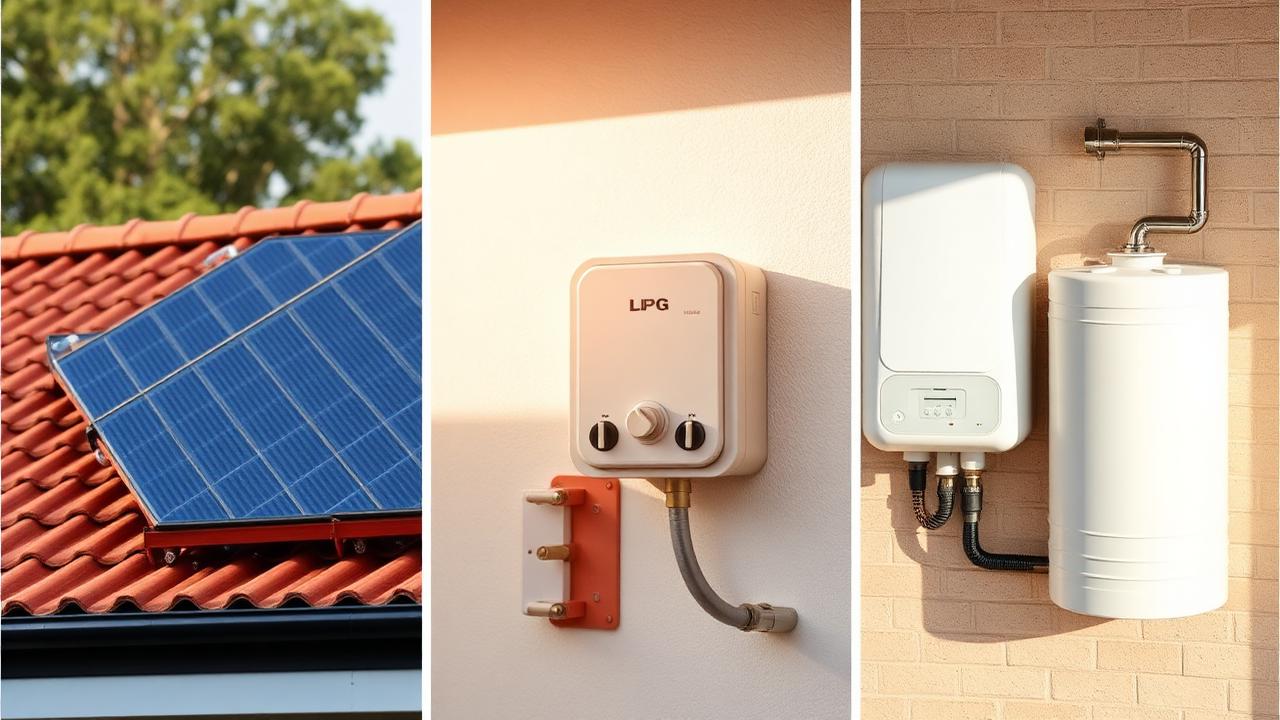
South Africa's ongoing load shedding crisis, rising electricity tariffs, and increasing environmental awareness have pushed millions of homeowners to ask a question that simply didn't come up a decade ago: is a standard electric geyser still the best option for heating water in my home? The answer, increasingly, is no — but choosing between a solar geyser, a gas geyser, and a traditional electric geyser involves tradeoffs that depend on your budget, your household size, your location, and how much disruption you can tolerate during the transition.
This guide compares all three systems honestly, covering upfront cost, running cost, reliability, load shedding performance, lifespan, maintenance requirements, and which type of household each option suits best.
How Each System Works
The Traditional Electric Geyser (Storage Geyser) The standard South African home geyser is an insulated steel tank — typically 100 to 200 litres — with an electric resistance element inside that heats water and a thermostat that maintains it at a set temperature (usually 55°C–65°C). It stores hot water continuously, keeping it ready at any time. It is connected to the municipal cold water supply and draws power from the grid every time the water temperature drops below the thermostat set point.
The Solar Water Heater (Solar Geyser) A solar water heater uses rooftop collector panels to absorb heat from the sun and transfer it to water in a storage tank. There are two main types used in South Africa: flat plate collectors (more common in moderate climates) and evacuated tube collectors (more efficient in cold or cloudy conditions, widely used in Johannesburg and the Highveld). Almost all solar systems include an electric or gas backup element for days when solar gain is insufficient. The storage tank may be mounted on the roof (thermosiphon / close-coupled system) or on the ground (split system with a pump).
The Gas Geyser (Instantaneous / Tankless Gas Heater) A gas geyser heats water on demand — there is no storage tank. Cold water flows through a heat exchanger inside the unit, and LPG (liquefied petroleum gas) burners heat it as it passes through. Hot water is available within seconds of opening a tap, and the gas burner switches off the moment the tap is closed. Gas geysers are available in different flow rate capacities, measured in litres per minute (LPM), and must be properly sized for the household's simultaneous hot water demand.
The Comparison: Solar vs Gas vs Electric Geyser
1. Upfront Cost and Installation
| Electric Geyser | Solar Geyser | Gas Geyser | |
|---|---|---|---|
| Unit cost | R4,500 – R9,000 | R12,000 – R35,000 | R3,500 – R12,000 |
| Installation cost | R2,500 – R6,000 | R3,000 – R8,000 | R3,000 – R8,000 |
| Total installed cost | R7,000 – R15,000 | R15,000 – R43,000 | R6,500 – R20,000 |
Electric geyser has the lowest upfront cost and the simplest installation — virtually every licensed plumber can install one, and parts are universally available.
Solar geysers carry the highest upfront cost, driven by the collector panels, insulated storage tank, and in split systems, the pump and controller. A quality evacuated tube system installed in Johannesburg costs R18,000–R28,000 for a family of four. This cost can be partially offset by solar rebate programmes where available.
Gas geysers have a moderate upfront cost for the unit itself, but the installation requires a licensed gas installer to complete the gas supply connection — a separate certification requirement from standard plumbing. If LPG cylinder infrastructure does not already exist on the property, the cost of regulators, pipes, and cylinder cage adds R2,000–R5,000 to the initial outlay.
2. Monthly Running Cost
This is where the comparison becomes most meaningful for South African homeowners facing Eskom tariff increases of 12–18% annually.
Electric geyser: The single largest electricity consumer in most South African homes, accounting for 30%–40% of the monthly electricity bill. A standard 4kW element in a 150-litre geyser costs approximately R400–R800 per month to run at current Johannesburg electricity tariff rates, depending on household usage.
Solar geyser: On a good solar day (of which Johannesburg has approximately 300 per year), the solar collectors provide all the energy needed to heat water with zero electricity cost. With a backup electric element, electricity consumption is typically reduced by 60%–80% compared to a standard geyser. Average monthly electricity saving: R250–R600 for a family of four. Full payback period at current tariffs: 5–10 years depending on system size and usage.
Gas geyser: LPG costs in South Africa currently sit at approximately R28–R40 per kilogram (prices fluctuate with the rand/dollar exchange rate). A family of four using a gas geyser will consume approximately 15–25 kg of LPG per month for water heating, at a cost of approximately R420–R1,000 per month — broadly comparable to electricity costs, though shielded from Eskom tariff increases. Gas costs track global LPG prices and the exchange rate rather than Eskom.
3. Load Shedding Performance
This is arguably the most important comparison factor for most South African homeowners right now.
Electric geyser: ❌ Completely non-functional during load shedding. No power = no heating. If load shedding occurs during or before a high-demand period (morning showers), the geyser may not have recovered temperature in time.
Solar geyser: ✅ Fully functional during load shedding when solar gain is available. On sunny days, the solar system operates completely independently of the grid. The backup electric element is unavailable during load shedding — but on a good solar day, it is not needed.
Gas geyser: ✅ Completely load shedding proof. Gas geysers operate entirely independently of the electrical grid (most modern units use a piezo ignition or small battery igniter). Hot water on demand, at any time, regardless of Eskom's schedule.
4. Hot Water Availability and Consistency
Electric geyser: Hot water is always available from the storage tank — up to the tank capacity. Once the tank is depleted (after multiple back-to-back showers, for example), recovery takes 1.5–3 hours. Temperature is very consistent.
Solar geyser: Hot water availability depends on weather and time of day. On overcast winter days — common in Johannesburg during June and July — solar gain may be insufficient, and the backup element must carry the load. In summer, hot water availability is excellent and often exceeds demand. Temperature can vary slightly based on solar conditions.
Gas geyser: Unlimited hot water on demand — there is no tank to deplete. As long as LPG is available, hot water flows indefinitely. This makes gas geysers ideal for large households or homes with high simultaneous demand. However, the flow rate (measured in LPM) must be correctly sized — an undersized unit struggles to supply adequate pressure to multiple outlets simultaneously.
5. Lifespan and Durability
Electric geyser: 8–12 years average lifespan. Tank corrosion (addressed by the sacrificial anode rod), element scaling from hard water, and thermostat wear are the primary failure modes.
Solar geyser: 15–25 years for the collector panels; 10–15 years for the storage tank. Evacuated tube collectors can be individually replaced if a tube is damaged. The longest-lived option of the three when properly maintained.
Gas geyser: 10–15 years average lifespan for quality units. No tank means no tank corrosion. The heat exchanger and burner are the primary wear components. Lifespan is highly dependent on water quality and maintenance frequency.
6. Maintenance Requirements
Electric geyser: Annual inspection recommended — checking the anode rod, element, thermostat, T&P valve, and PLV. Relatively low maintenance overall. Anode rod replacement every 3–5 years prolongs tank life significantly.
Solar geyser: Collector panels should be cleaned periodically (dust, bird droppings, and Highveld pollution reduce efficiency). The backup element and thermostat require the same maintenance as a standard geyser. Split systems with pumps require pump and controller maintenance. Overall maintenance is moderate and important — a neglected solar system loses efficiency rapidly.
Gas geyser: Annual professional service required — checking the burner, heat exchanger, ignition system, and gas connections for leaks. Gas installations must be inspected and certified. Maintenance is important for safety as well as performance.
7. Safety Considerations
Electric geyser: Primary risks are electrical — a properly installed unit with functioning T&P valve, PLV, and expansion vessel is safe. The main danger arises from outdated or poorly maintained components, or DIY installations without a CoC.
Solar geyser: Generally very safe. The main considerations are structural — roof-mounted systems (thermosiphon) add significant weight to the roof structure, which must be assessed before installation. Overheating can occur in summer if the backup element thermostat malfunctions in combination with high solar gain — quality systems include anti-legionella and anti-scald protection.
Gas geyser: Requires the most careful installation and maintenance of the three. Improper gas connections or poorly ventilated installations create risks of gas leaks, carbon monoxide poisoning, and fire. A gas geyser must be installed by a registered gas installer and must be located with adequate ventilation as per SANS 10087-1 standards. Annual safety inspections are not optional — they are essential.
Head-to-Head Summary
| Factor | Electric Geyser | Solar Geyser | Gas Geyser |
|---|---|---|---|
| Upfront cost | ✅ Low | ❌ High | ✅ Medium |
| Monthly running cost | ❌ High | ✅ Low | ✅ Medium |
| Load shedding proof | ❌ No | ✅ Mostly | ✅ Yes |
| Unlimited hot water | ❌ Tank limit | ❌ Weather dependent | ✅ Yes |
| Lifespan | ⚠️ 8–12 yrs | ✅ 15–25 yrs | ✅ 10–15 yrs |
| Maintenance | ✅ Low | ⚠️ Moderate | ⚠️ Moderate |
| Safety | ✅ Simple | ✅ Low risk | ⚠️ Requires care |
| Installation complexity | ✅ Simple | ⚠️ Moderate | ⚠️ Requires gas cert |
| Best for load shedding | ❌ | ✅ Daytime | ✅ Any time |
Which Type of Household Should Choose Which Geyser?
Choose an Electric Geyser if:
- Budget is the primary constraint and upfront cost must be minimised
- You are renting and a major system upgrade is not viable
- You already have solar panels or a battery inverter system that powers the geyser during load shedding
- You are replacing a failed geyser urgently and cannot wait for solar or gas installation timelines
Choose a Solar Geyser if:
- You have a longer-term perspective and can absorb the higher upfront cost
- Your roof faces north (in South Africa) with minimal shading
- You want the lowest possible long-term electricity bill for water heating
- You are in an area with high annual sunshine — which includes virtually all of Johannesburg and Gauteng
- Environmental sustainability is important to your household
Choose a Gas Geyser if:
- Load shedding resilience is your primary concern and you want 100% grid independence
- Your household has high simultaneous hot water demand (large family, multiple bathrooms used at once)
- You have or are willing to install LPG cylinder infrastructure
- You want the benefits of on-demand heating without the high upfront cost of solar
- You live in an apartment or complex where roof installation is not possible
The Hybrid Option: Heat Pump Geysers
Worth mentioning alongside the three primary options is the heat pump geyser — increasingly popular in South Africa. A heat pump works like a reverse air conditioner, extracting ambient heat from the surrounding air and using it to heat water. It uses electricity but operates at 3–4 times the efficiency of a standard resistance element — meaning it produces the same hot water volume for 60%–75% less electricity.
Heat pump geysers cost R18,000–R35,000 installed — similar to solar — but work at night, in winter, and in shaded locations where solar panels would underperform. They are an excellent option for homeowners who want dramatically lower electricity bills without the constraints of roof orientation or LPG supply.
What the Law Requires in South Africa
All geyser installations — electric, solar, or gas — must be carried out by a PIRB-registered plumber. Gas installations additionally require a registered gas installer certified under the Pressure Equipment Regulations. Upon completion, a Certificate of Compliance (CoC) must be issued. Without a CoC:
- Your home insurer may reject any related claim
- The installation is illegal under the National Building Regulations
- Liability for any consequential damage rests with you
Always request and retain your CoC for any geyser installation.
Cost Comparison: 10-Year Total Cost of Ownership
Factoring in purchase price, installation, maintenance, and estimated running costs over 10 years for a family of four in Johannesburg:
| Electric Geyser | Solar Geyser | Gas Geyser | |
|---|---|---|---|
| Initial installed cost | R11,000 | R23,000 | R13,000 |
| 10-yr running cost (est.) | R72,000 | R18,000 | R60,000 |
| 10-yr maintenance (est.) | R5,000 | R8,000 | R10,000 |
| 10-yr total cost (est.) | R88,000 | R49,000 | R83,000 |
Estimates based on a family of four, current tariff rates with 15% annual Eskom increases factored in, and average LPG pricing. Individual results will vary.
The solar geyser wins decisively on 10-year total cost — despite having the highest upfront investment. The electric geyser is the cheapest to buy but the most expensive to run. The gas geyser sits in the middle, with costs that are shielded from Eskom increases but exposed to LPG price fluctuations.
The Verdict
There is no single "best" geyser for every South African household. But based on the most common priorities in 2025:
- Best overall value over 10 years: Solar geyser — particularly in Gauteng's sunshine-rich climate
- Best for immediate load shedding resilience: Gas geyser
- Best low-upfront-cost option: Electric geyser — especially paired with an existing inverter or solar PV system
- Best efficiency with no roof or gas constraints: Heat pump geyser
If you are replacing a geyser today and load shedding is your main concern, a gas geyser is the fastest, most affordable path to grid independence. If you are planning ahead and want to minimise long-term costs, a solar geyser or heat pump is the smarter investment.
Either way — get a professional assessment from a PIRB-registered plumber before deciding. The best system for your home depends on your roof, your gas access, your usage patterns, and your budget.
Ready to Upgrade Your Geyser in Johannesburg?
Joburg Plumbers connects you with verified, PIRB-registered plumbers who specialise in solar geyser installation, gas geyser installation, and standard electric geyser replacement across all areas of Johannesburg — including Sandton, Randburg, Roodepoort, Midrand, Fourways, Soweto, Boksburg, Germiston, Kempton Park, and across the East Rand, West Rand, Joburg North, and Joburg South regions.
Get a quote. Make the switch. Never run out of hot water during load shedding again.
This article is intended as general guidance only. All geyser installations must be carried out by a PIRB-registered plumber and, for gas systems, a registered gas installer. Always obtain a Certificate of Compliance upon completion.